Overview
Hyper-Myths Counter-Rituals
17/10/2025 – 17/01/2026
Curated by Manuel S.Mendonça
Essay by Martina Menegon (artist in the exhibition)
Essay October 2025
“All it took was one knot in time then the world changed then the memory disappeared then we couldn’t understand life anymore neither forward nor backward.”— Lucile Olympe Haute
Myths have always been a permanent feature of cultural life and imagination. Embedded in rituals and narratives, they offer ways of arranging, inhabiting, and understanding the world beyond the scientific logical framework that dominates modern Western thought. Myths are ways of making sense, systems of meaning that extend beyond explanation into the realms of ritual, imagination, and power. In doing so, they generate another kind of subjectivity and rationality: non-linear, non-binary, non-logo-centred, and non-anthropocentric.
Far from being irrational or archaic, myths are a recurring and alternative practice of world-making. They tend to re-emerge when certainty fractures, when society loses its grip on the structures of knowledge and truth, and when reality can no longer be taken for granted. It is no wonder, then, that in our unstable present, marked by saturation and dystopian excess, where reality feels dissonant, unstable, corrupted, and hostile, and where shared truths and rights collapse, myth-making resurfaces as a way of confronting and reshaping the conditions of the present.
Today myths re-emerge through synthetic narratives, hybrid figures, embodied practices, and entanglements with technology and more-than-human others. These hyper-myths create shifting meanings that make fractured realities inhabitable, affirming their power to create interconnected forms of subjectivity, strategies for survival and resistance, and to nurture more sustainable ways of becoming. They are symbolic structures that both unsettle and embody the hybrid condition of our time, offering a
way to reimagine meaning and subjectivity when other systems have collapsed.
“We are corporeal, biological, incarnate entities, but also and simultaneously: relational and informational beings. […]
Let’s understand that everything is interconnected, that consciousness gives shape to reality and reality gives shape to consciousness”. — Lucile Olympe Haute
Amidst instability and crisis, a longing for profound connection re-emerges, one that understands all things as interconnected and entangled, where consciousness and matter are inseparably bound in the making of reality. This search is itself ritualistic, a repeated practice of making meaning through patterns of relation and interdependence.
While myths and rituals can exist independently, they often intertwine, with ritual turning myth into embodied, shared experience that creates a sense of belonging and significance. Rituals take man forms: gestures of care and mourning, collective gatherings, embodied repetitions, offerings to the more-than-human world. Today rituals extend into new terrains, from the intimate and everyday to the mediate and technological. Through endless scrolling, rhythmic swiping, or the daily offering of data, they also manifest as patterns of information, attention, and presence, with algorithms sometimes imagined as oracles, mysterious and inscrutable forces that both oversee and control. Rituals, whether ancient or emergent, are never neutral. They can reinforce systems of control, but they can also be unsettled, reclaimed, and transformed into gestures of refusal, resistance, or collective strength. They are a contested space, at once deeply personal and profoundly political.
It is in this tension that counter-rituals emerge: practices that resist capture by systems of power, reclaim embodied repetition as gestures of solidarity, or invent new symbolic forms for living otherwise. Counter-rituals reveal how ritual can be weaponized in the service of control, while insisting on its potential as a site of care, refusal, more-than-human kinship, and collective transformation.
Hyper-myths and counter-rituals are conjured as both continuity and rupture, a compass and a glitch, a way to resist closure and to re-enchant reality with speculative possibilities. As forces of transformation, they affirm that imagination and creative thought are essential to opening unruly, collective, and synthetic futures, where cognition itself is hybrid, partial, and profoundly mythic. It may be no coincidence that witches, monsters, cyborgs, and chimeras rise again, though they have never disappeared, as powerful figures through which to think and become otherwise.
“Let’s invent experimental origins and traditions for ourselves. […] Let’s mix ancestral and invented
methods to reveal the porosity of the worlds.”
— Lucile Olympe Haute
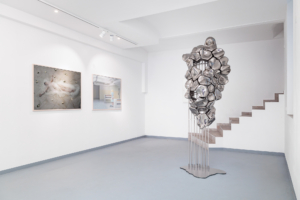
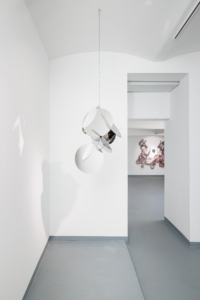
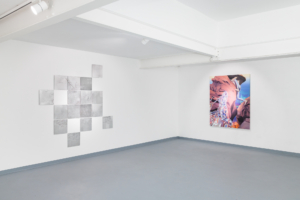
Art becomes a crucial site where these transformations are made visible, tangible, and affective. Artists conjuring hyper-myths stage them as critical practices of intervention and reimagination. They may appear as heroic archetypes, saintly icons, or religious motifs reworked to reveal their entanglement with violence, ideology, or spectacle. Others take shape as hybrid beings and uncanny embodiments, where the body itself becomes a site of instability, multiplied and reconfigured through digital tools.
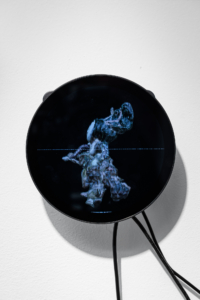
Some unfold through processes of ritualization, where repetition, algorithmic loops, or the manipulation of digital media become rites of transformation. Artists reclaim cyclical temporality as a mythic structure that resists linear progress, echoing quantum entanglement and its refusal of closure and permanence[12] , opening instead toward indeterminate futures, non-linear kinships, and speculative rhythms of becoming. Others project hyper- myth into speculative futures, weaving new folklore for ecological survival, posthuman kinship, or collective becoming. The constellations are infinite, revealing how hyper-myths can be continually reimagined across artistic practices.
Alongside these hyper-mythic expressions, artists also generate counter-rituals, performed across bodies, materials, and technologies. These unsettle order, reclaim what was once abject, and mobilize it as a critical companion for imagining alternative futures. In some works, code operates like incantation, glitches like conjurations, loops like chants. In others, ritual takes shape through repetition, gesture, or the reworking of symbolic forms. Artworks become pharmakeis, oracles that translate the unreadable and summon networks of meaning, holding together disruption and transformation.
Counter-rituals reimagine ritual as a generative force of resistance and collective invention. Art becomes the stage for shared fabulations and re-enchantments, from collective spellwork to glitching code, affirming its vital role as a space of imagination, survival, and care, and as a ground for unruly, shared futures rooted in symbiotic entanglements.
_______
FEATURED ARTISTS:
Beáta Hechtová (Czech Republic)
Cinzia Campolese (Italy)
Evelyn Bencicova (Slovakia)
Honza Pos (Czech Republic)
Maria Belova (Russia)
Martina Menegon (Italy)
Rebekka Friedli (Switzerland)
Simon Goritschnig (Austria)
Valerie Messini & Eva Schlegel (Austria)
_______